
How Wearing a Corset Affects You and Your Clothes

We’ve all heard the horror stories and seen the illustrations of how our corsets supposedly squish our bodies, but what about the ways in which they affect our appearance?
A corset’s most obvious effect is the reduction of the waist. The amount of reduction today’s fetish corsets achieve (up to 10″) is actually far past the historical norm even if the proportions are not. For example, “The Corset: Questions of Pressure and Displacement,” a study preformed by Robert L. Dickinson for The New York Medical Journal in 1887, sought to calculate the force of the pressure exerted on the body by the average corset and that pressure’s effect on the health of the wearer. It is an excellent article with lots of numbers for those of you who, like me, like to know a bit more about the math and science side of history!
In his study, Dr. Robert Dickinson states that, “Six inches difference between the circumference of the waist over the corset and the waist with the corset removed is the greatest difference I have measured. Five and a half and five I have met with once each. The least difference is in those cases where the measurement with and without is the same. The average contraction of the 52 cases given in the table is 2½ inches. The maximum there is 4½ inches, the minimum 1 inch.”
Note that the doctor encountered cases in which the with and without corset measurements were the same. How can that be? If you aren’t reducing your waist measurement, why bother wearing a corset at all?
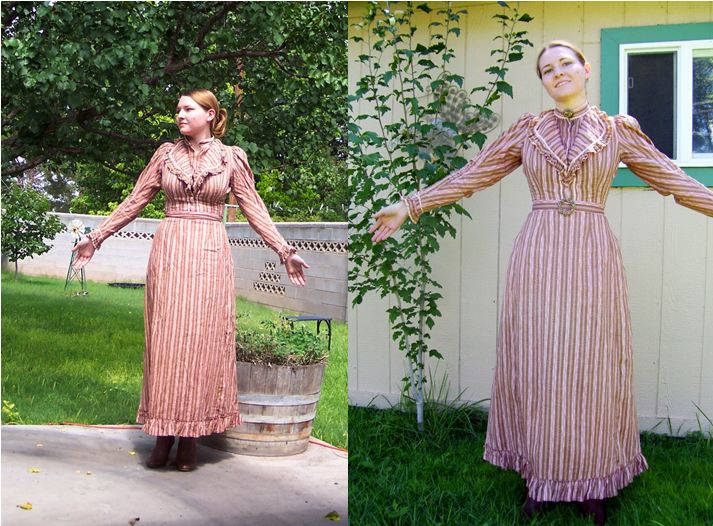
Measurements without a corset (left): 36″ x 28″ x 35″
Measurements with a corset (right): 35″ x 28″ x 35″
The photo above shows me in the same dress without and with a corset. Notice how much more smoothly my dress fits with a corset and how the bust is higher and slightly reduced, yet my waist measurement remained constant. The corset not only adds its own thickness, but rounds out the waist, a subtle, yet important factor to consider.
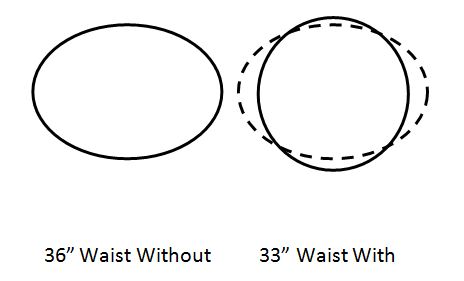
The oval on the left is a cross section of a 36 inch waist without a corset and the one on the right is taken in 3 inches with a corset. The shapes are to scale (remember: slight math nerd).
For many people, the human body looks skinnier from a side angle than from the front. The corset draws in the sides of the body, thinning the front view while making the waist more circular and increasing the thickness of the body. So I look smaller from the front even though my actual size hasn’t changed.
So why did/do we wear corsets? The answer lies in that fact that corsets act as more than just a measurement reducer. In fact, there are other effects a corset has on the figure that are just as important as its waist reducing properties, especially when it comes to determining historical health and beauty ideals.

Before and After, Spencer Corset Ad from 1941
Pre-20th century ladies aren’t the only ones who benefit from steel and whalebone. Until the 1970s, girdles were still essential for girls to get the nip and lift they needed.
One of the major features of a corset aside from its reduction capabilities is its rigidity and support. Further into his report, Dr. Dickinson mentions that one of the participants in his study only wears a corset to go out and works without a corset at home. He notes that because of this, her abdominal muscles have remained strong while other ladies, whose muscles have the corset to do the work for them, have weak “paunchy” abs (which I have gained even without wearing a corset. *sigh*).
The nudes of the era that feature soft, doughy forms were appreciated because most of the women, once freed from their corsets, sprang back to their natural size, but with soft bellies and low, fleshy hips. Today we consider tight, toned bodies sensual and untoned bodies casual, quite the opposite of yesteryear. However, if we looked toned everyday in society and kept our natural jiggle hidden except in the most intimate of settings, our ideas of sensuality might also reverse.

“Nana” by Edouard Manet, 1887
In a world without underwires and Spanx, the female body would quickly succumb to gravity. One of the main functions of a corset is to support the breasts. If you are like me and have boobs much too large for your frame, you know the hazards of going braless: stretch marks, painful jiggle, and general sag. It’s not fun; it’s not pretty; and the darn things can get in your way! A corset holds them up and back, like a levee lest those girlies runneth over while you’re doing laundry, cooking, or being jolted around by a runaway quarterhorse. It also provides shape to the chest which is more telling of an era’s trends than the size of the waist reduction. Thus we get Regency’s high breasts; the Romantic period’s large, wide breasts; the soft, rounded Civil War breasts, the high mono-boob of the bustle era, and the pendulous pigeon-breasts of the Edwardian era. Most misconceptions about frumpy 19th century fashions come from trying to wear the styles without the right foundation garment. A late Victorian gown just isn’t the same without its corset companion.
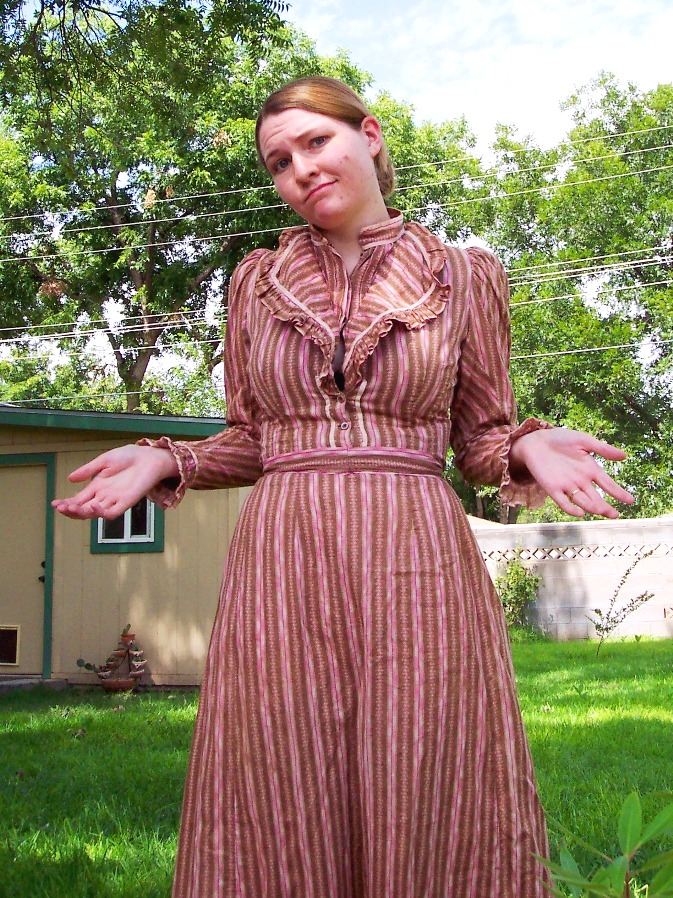
Besides its effect on the natural state of the body, the corset had an equally vital role in fashion development. Without it, none of the fashionable trends we’ve come to love would be possible. Again in his report, Dr. Dickinson describes what happens when a woman tries to wear the popular fashions from 1887:

“In the woman who wears no corsets the many layers of bands about the waist on which heavy skirts drag are sufficient to cause considerable constriction” – Dr. Robert Dickinson
A corset is essential…ESSENTIAL…to wearing any period gown not only to achieve the desired silhouette, but because some historical dresses are HEAVY. I have a simple 1870s wool gown with no extra buttons, beading, or trims besides a plaid capelet. There are the obligatory bones inside the bodice to further support the shape and all told, the thing weighs 6 pounds 5 ounces. That’s without the cage, petticoat, slip, and underskirt. If it had all the bells and whistles of high fashion like draping fringe, bows, and miles of ruffles, the weight increases dramatically– up to 15 or 16 pounds! Other styles, like the mounds of petticoats from the 1850s, would actually bruise your hips from the weight. A corset offers protection from the weight of a gown in addition to giving the fabric the smooth support it needs to keep from straining and sagging.

Court Dress, circa 1775
An 18th century silhouette relies on stays to give the torso a cone shape and to flatten the front of the bust upward.
The corset is undoubtedly one of the most intriguing pieces of clothing ever devised. It is both functional and fascinating, crossing the realm between necessity and vanity. The daily fashions of the 2010s rely on exercise, good genes, and diet to achieve our ideal body shape, but the corset still lingers in spite of the changing times. Will it ever leave us? Well, with the ability to give me a neatly defined waist where otherwise I have none, I don’t think my spiral steels will be leaving my closet anytime soon!

Happy Costuming! :)
For even more information about corsets and how they physically affect your body, I highly recommend visiting Lucy’s Corsetry. She is considered one of the leading authorities on modern corsetry and discusses everything from medical issues and myths to making your own!

 The Pragmatic Costumer
may i just passingly remark how stunningly victorian you look in that new corset+ gown? what’s gonna be the following epoch dressing adventure?
Thank you! I’ve got to summon something for Halloween, so we’ll see what happens. It’s all very nebulous right now, but I’m thinking either a mourning chemise de la reine or a tribute to 1890s fancy dress.
both sound like having a great potential to me! can’t wait to see the choice on you! :)
What a wonderful article! Well done!
I wish I could be able to wear corsets. My health condition does not allow me to do so, and I wish there was another alternative to make my costumes look more period. :(
Historical bodices almost always have a few small bones sewn into them that don’t restrict, but rather just support the fabric, giving you the supported look without the pinch. Or you can sew a layer of stiff fabric (quilting helps) into the lining, another historical way of propping up and smoothing out your silhouette. My other secret weapon: Sports bras! :)
Wow, that is some great ideas! Thank you. :D I’ll deffinitly try it for my next costume.
I recently tried a body shaper under an 1890s dress. It was very comfortable to wear and not restrictive, but gave me enough smoothing to hold the lines. For heavier clothing I don’t know what I would do tho.
Brava! Being another math/science nerd, I personally loved that you went to the extra effort to make diagrams to scale. With your permission, I’d love to reblog this. :)
Certainly! Information is made to be shared. :)
Excellent post! I always enjoy reading good, reasoned approaches to the corset.
Reblogged this on Lucy's Corsetry and commented:
A lovely, balanced and logical corset-neutral article that shows (using a study from the late 19th century) that the average waist reduction among 52 women was only about 2.5 inches. As Liz sums up nicely elsewhere in her blog, “Whether you are a lady or a gent, costumer or casual, tight-lacer or comfort-seeker, there is a corset for you!”
This article is well worth a read!
Another reason to wear a corset: Consistency. Clothes were expected to last and the monthly eccentricities of the average female form are well known to any person of the girl persuasion. :) It was essential to be able to maintain the same general size and shape for as long as possible for purely economical reasons if nothing else, since most women would not have had a separate wardrobe to accommodate changes in their personal size.
This was a very enjoyable article. Thank you for sharing!
So true! As I mainly do 18th century I always gets a bit amazed over those who refuses to wear stays underneath. It just don’t look right. Well, it might, I have friends are slender and bones the bodices heavily and they manage to get the right shape. Or you could opt for a shortgown or a Robe Battante where you can get away to go stayless. I’m thinking more of those ladies who insists on the gala look, but without any support- the result gets wrinkly and wrong.
They are usually the same ladies who tells me that wearing stays are uncomfortable (without ever having tried one) and who assumes that the only way to wear stays or corsets is to lace yourself within an inch of your life…
Great article! I was not aware of the study that averaged a 2.5″ reduction. Good to know most modern costumers fall in that same area.
An excellent article.I like the fact you show a picture of you with and without corset.There is nothing like visual support.
I was pondering just this question the other day. Which prompted me to compare measurements with corset compared to with a ‘t-shirt bra’. I was surprised to find that my waist measurement stayed at 28″ but my bust measurement increased. I wondered how you cope with the bottom of the corset when sitting down…I dislike the V shaped ones as it flips up.
The bottom of my utilitarian white corset is M shaped and fits loosely around my hips rather than tightly. I can bicycle and sit quite comfortably in it. My hips are bitty anyways, so I don’t need to reduce them, but I have a different underbust corset that is absolute hell to sit in because it sits snugly around my hips! I’ve also noticed the flip-up problem. Usually it happens when a corset is too long for my torso or has plastic bones. In antique portraits, you will notice many of the sitters are either deeply reclined or on the edge of their seats leaning forward, s-corset style. If you sit either of these ways, it stops the corset from flipping up, but it takes getting used to. My general advice is get a flex-steel corset that is at least an inch larger at the hips than your natural measurement. :)
Women used to sit with their knees apart, partially to accommodate the bottom of the corset but also so their skirts didn’t collapse into a heap on the floor. It isn’t really possible to lounge in a corset tho heaven help me I have tried after a long day standing lol. It probably depends on the era how your skirts fit but esp with 1860s styles its actually more comfortable.
Very informative article! I have that unusual “Upper triangle shaped” figure…similiar to yours, but in a bigger size, hahaha!
I have always thought that the stiffness of the female torse in a corset was one of the differences between women and men that was considered erotic in Victorian and Edwardian times. Women had to move differently, couldn’t slouch, and their body shape was displayed boldly, even if kept behind a picket fence of whalebone stays.
Sorry, I am a bit late in this thread.
Another important aspect of the corset throughout history was that it sent a message to others. The message could range from
“I have been well brought up and I am used to wearing a tight corset all day”
“Look at me, I have the required deportment and posture, only achievable with a corset”
“I am wearing a very restricting corset that limits my movements (in a 21 century sense – I can’t reach to the bottom shelf in the supermarket), but as a lady I don’t need to make outlandish movements, so effectively I am not restricted. I have maids that move things for me”.
Betty
I have read (unfortunately not quite sure where!) that girls and women who wore corsets in the Victorian period were recomended to do 10 minutes to a half hour exercise session every day to help reduce their stomach and to balance their humours! I doubt if they did it boot camp style but the theory was and still is sound. Just because you wear corsets does not mean having to sacrifice a flat stomach!
Great article. The article does address what I have always believed that there are serious health benefits to daily wearing either a corset or a girdle. The problem we as humans have is the fact that we stand erect standing erect with a combination of gravity and over a period of time age has a very negative effect on our internal organs. Wearing either a decent vintage girdle or a corset everyday without question will counteract this negative effect and support your internal organs holding them and your stomach in their normal natural position. There are for sure health benefits to being corseted or girdled everyday.
There is also a misconception that a girdle or a corset is for getting all dressed up, a girdle – corset should be worn everyday even when just relaxing around your home to get the full health benefits.
Women in my opinion do a major disservice by not wearing a combination of a bra and a girdle or corset everyday. This combination worn daily will give you needed control and support, they both compliment each other.
Interesting enough males also can benefit from wearing a corset or a girdle. Males also are effected by the same negative problems of standing erect, gravity, and age. Males by not wearing a girdle or corset will have negative effect on your overall health.
When choosing to wear a girdle or a corset and a bra it is recommended to try and locate a professional corsetiere for a fitting and some helpful consulting.
The difference between a girdle and a corset – a corset will pull your belly in and help in a positive way with figure training and reshaping and molding figure with improved posture sitting and standing. After your figure is the way you need it you should without question be in a decent vintage style girdle. A girdle helps hold and supports your figure. When out of corset you really should be without question in a girdle everyday.
Keep in mind wearing a corset and girdle does take some getting use – it can take a few weeks, but once you are use to the being in a decent vintage girdle or a corset – that is firm boned and zippered trust me you will love the positive effects. You feel much more energy and confidence, it is rather amazing.
Come and join us for a discussion on girdles and corsets we would love hearing from you:
http://www.voy.com/224381/
Plus we if you would like to chat about girdles and corsets come to: http://www.chathour.com/chatroom/Girdle_Chat
You look marvelous in your corset and dress. Lovely article, thank you. will share on my Page, as I agree that foundation garments (of whatever variety) are essential to creating historically accurate ensembles, as well as looking pulled together in your vintage or modern wardrobe.
Here, here. As I age I am finding I have a desire for a more “pulled together” look and I think foundation garments is the answer. Until I can afford a corset I am going to look to an open bottom girdle.
Cheers,
Lyric
Hi,
If you want to know why corsetry was considered evil then you need to look further than fashion. I took the courses at Dalhousie and was lucky enough to get the opportunity to actually go through the archives in the Saint John Museum in New Brunswick Canada. While there, we were shown the famous ‘glass dress’ from the worlds fair in 1893 I think it was… Anyway what I saw evidence of was not the corseting of adults in their records but the corseting of babies and small children to make them grow straight. Doctor’s records showed the recommendation to corset as tightly as the child can take and still breathe over and over again. children as young as 18 months were corseted and swaddled because it was believed to be unhealthy to move wilst asleep at a young age. If you wish to know more about this from an actual historical point of view… find Lynne Sorge. She was our Department Head and was writing her either doctoral or master’s thesis on the effects of corsetry on the human body. She also teaches/taught at Central St. Martins in England and I believe Janet Arnold was one of her instructors/mentors. These people looked the way they did because their bodies were formed that way from a very young age… like bonsai trees, only with people. Note* if you are corseted every moment from the time you are able to move on you own, you will simply not have developed musculature… aesthetics not withstanding.
Babies have been swaddled for thousands of years throughout cultures and continue to be swaddled. I have never heard anyone relate it to the negative effects of corsetry before now and it seems slightly silly to me to compare the two since swaddling fully encompasses a body of an infant and the other is a support garment for women. Yes, women did have their bodies shaped from an early age, but it was not punishment or torture the way people describe (For example, the myth of young girls being stretched and strapped into extremely tight corsets originates in fetish literature popular during the 1890s. It’s kind of unsettling that many modern folks consider antique child pornography to be fact). Children’s corsets were not overly hourglassy at all and were used as back supports. I’m sure there were, as there are now, “pageant-type” moms that encouraged their underage daughters to begin lacing too tightly too early, but in general, this was not the case and was strongly discouraged since tight corsets were seen as sexualizing. What was encouraged, however, is good posture. Until the past 30 years or so, people valued posture very, very highly and corsets were treated as support garments to encourage straight growth of the spine. There is nothing evil about wanting your child to grow a healthy spine. A major part of health classes in the 19th and 20th centuries was learning to stand correctly. Now we have to have radio commercials urging parents to watch their child’s posture because cases of scoliosis and other spine-deforming diseases are going unnoticed and uncorrected. Modern medical practice has removed the need for most children to default to corsets (any minor seeking to wear corsets should seek medical advice from their doctor first), but corrective medical braces/corsets do still exist and still perform like their predecessors. The future always views the past as horrific and unsurvivable because we get so used to having new technologies we forget that our ancestors were dealing with many more unknowns. Perhaps 100 years from now, prosterity may view our practice of pumping children full of toxic chemicals to cure cancer as highly barbaric and cruel thanks to new technologies that can cure cancer with much less pain, but because of their advancements, they will not understand the fear and uncertainty we face now. Retrospect is hard to do without our modern views coloring our vision. I wrote this article because I found that everyone is so preoccupied with the “thinning” aspect of corsets that they loose sight of its original function: support for the body and garments. I think this speaks volumes about our modern thought processes. We are so focused on being thin and “in shape” “naturally” that we project that view on history, distorting it. Perhaps a more in-depth article is in order! Thank you for the inspiration. In the meantime, please take a moment to peruse Lucy’s Corsets and Health playlists on YouTube for more information, if you are curious!
The past thirty years? I’m sure you have relatives who are older than 30. Ask them if they wore corset as children. I doubt it, “good posture” being valued or not. My grandmother was born in 1935 and didn’t wear anything but undershirts before she graduated to bras. And my mother, considerably older than 30, remembers how ridiculously cruel corsets sounded to HER as a teen. Slapping a corset on every child wasn’t how good posture was encouraged.
Very few children have to endure cancer treatments but most back in the day were forced into restrictive corsets. I know, little girls were supposed to play with dolls and do handicrafts, not play rough. But few little girls would want to be sedentary all the time. Yet that was the only choice they had. How healthy is someone who never exercises because she plain can’t? The poor child couldn’t even lace up her own shoes.
Thank you for a well written and I am going to assume researched article. Several years ago I thought I was ready for tight-waisting. Unfortunately I did not have the commitment necessary and from the reading I had done I realized I could not afford a custom made corset and even a self made one was cost prohibitive.
This article reminds me of why I wanted to give it a try. These days I would be interested in wearing a corset every now and again; i.e., when out and about. I live in a semi-tropical area and wonder how women handled the heat “back in the day”.
Your image with the corset looks much nicer than sans corset. I will definitely be consulting the supporting articles you have suggested. One day soon I hope to find a way to obtain a decent corset.
Again, thank you for sharing your expertise.
Cheers,
Lyric
You might want to look into cotton and mesh corsets, both of which are historically accurate and more suitable for warmer climes than synthetic fabric corsets. If you would like to “test the waters” so to speak, an off the rack (OTR) corset is a good place to start before investing in a custom corset. If you are interested, I recommend checking Lucy Corsetry’s “Lacebase” to find one that will best work for your body: http://lucycorsetry.com/research-corset-brands/corset-dimensions-directory/
Thank you for responding, Liz. As a sewist I would also like to tackle making my own. You’ve been a big help.
Cheers,
Lyric
Reblogged this on Lily Absinthe and commented:
This is probably one of the most compelling explanations in regard to the role of the corset and clothing of the 19th and early 20th Centuries.
I can tell a corset body by looking near the bottom of the belly an leg opening>> this pic https://instagram.com/p/4HtRCZFPN8/?taken-by=londonandrews is a perfect example of a corset body. My question is does that affect movement or bending or maybe your insides.
Here is another example https://pbs.twimg.com/media/CJbS2LgWIAA-g7Z.jpg
Thats not natural, Or maybe they just arent doing it right, dont get me wrong it looks good but u see the hip crease, im wondering if that affects health an does it hurt
A NSFW warning would have been nice for the pics, but to answer your question: That’s fat displacement/distribution. You cannot judge “proper” corset wear from the uncorseted body shape as plenty of women do look like that without corset wearing. Bodies store fat in many different places depending on your genes and long-term fat displacement occurs from wearing tight clothes of any sort, not just corsets. Jeans, panties, and belts all can create divots and curves, too. Many men experience similar “shaping” when they wear pants with a tight belt around their hips for years. The resulting shape my not be genetic, but it is “natural” because that is naturally how the body responds to pressure points. Pressure can be painful, but proper corset training should not be. The only outward sign of an improperly fitted/worn corset with the corset off is bruising. As for movement and insides, those are great questions that have all been tackled by the wonderful Lucy of Lucy’s Corsetry! Here is a link to a video playlist that may have the answers you are craving: https://www.youtube.com/playlist?list=PL0F578952365CE673
This is an excellent article!
It has me wondering though, since I can’t find the information anywhere, does the simple reduction of lacing a corset round the waist, or is there a certain shaping with the seamlines and bones that attains this?
The rounding is mostly do to garment construction and simple physics. You can devise patterns that maintain a slimmer profile from the side as well as the front (through panel shaping and, often, a curved busk), but some rounding of the waist is inevitable. The flesh displaced by the reduction must go somewhere!
That’s the part I’m having trouble figuring out, since none of my books mention it specifically. Many corset patterns I’ve seen have even, vertical seam lines, but then some seem to curve towards the front. I’ve a very slight figure with not much to restrict and my patterns always end up with a more oval waist line, but I can’t quite figure out how to achieve this silhouette (and my dress forms don’t help, either, I can’t find one small enough!)
I am supposing you want a rounder waistline, but if that’s not the case, please correct me! The lack of rounding is likely due to your already slight figure (especially if you are already a hourglass shape), so there is not as much flesh displacement. It could also be from your pattern cupping the ribs rather than being more cone-shaped since cupped rib patterns tuck under the rib-cage and displace flesh up or down rather than around. Since I’m not a professional corsetier, I can’t really offer much advice, but I do know that Lucy of Lucy’s Corsetry (https://www.facebook.com/bishonenrancher) could probably help you find an answer or at least point you towards someone who can! Having an oval waistline isn’t bad by any means. Many modern corset-wearers prefer a more natural, oval waistline that helps maintain slimness from the side view as well as the front, and consider it a feature!
Reblogged this on Crazy Little Redneck Goth and commented:
The desire to share this well thought out article was strong.
Hi! So since corsets don’t need to be laced tightly in order to reduce the waist too much, could someone wear a bustier to get the smooth look under those kinds of dresses? Like the ann cherry ones?
Thank you for any help.
Bustiers, girdles, and other shapewear won’t give you as much of a reduction as a well-fitted corset, but if smoothing and light lifting is what you’re looking for, Spanx and similar garments can perform that job well. Just make sure to choose one that is comfortable on your body in your particular situation and don’t try to wear one that’s too tight. I have a Rago 821 that is very comfortable: breathable, sturdy, and flexible. I wear it under vintage dresses. I avoid latex and rubber fajas/cinchers since they are hot, sweaty, and irritate my skin. If you are weighing your undergarment options for a Victorian costume, I actually wrote an article about it here: Support Garment Showdown: Options for Creating a Victorian Look With or Without a Corset
Thank you! Do you also have any tips about beginner corsets, that I could just use for lighter lacing? I wanted the bustiers since they seemed more inexpensive. I did a search but I didn’t find any articles mentioning beginner corsets….Any info would be appreciated.
Or, could I wear one of those costume corsets? Like the ones you’d find at party/halloween shops?
A good starting point might be an inexpensive “off the rack/ OTR” corset from one of the basic brands like Orchard Corset (which start around $60). I have one of their underbusts (a CS-411) which I wear with late Victorian and early Edwardian costumes and it is a good basic corset. I reviewed it here.
Since you’ve never owned a corset before, I highly recommend visiting Lucy’s Corsetry website and/or YouTube channel. She is one of the foremost experts on corsets and has information on nearly every topic! Her Guided Galleries offer lists of corsets suitable to your body type (for example, if you have big hips or a long torso, she lists which corsets will fit your body best). She is always willing to answer questions on her Facebook page as well. I am also a fan of Waisted Lives on Tumblr, which has this handy Beginner’s Guide and FAQ about corsets and waist training.
I was nervous the first time I bought a real corset, but now I am very pleased I did! A well-fitting corset makes me feel pretty and proper in my costumes. But, if you decide they aren’t for you, that doesn’t mean you don’t have other options. My best advice is to do a little research and make sure you are comfortable and happy. :)
I’m sorry for the late reply, but thank you for the extra information! I will look into everything. And I <3 Lucy's channel also!!
Great article!
Many people have absolutly no idea of the difference between a corset and a girdle. A corset is really great for molding and shaping your figure. A corset will pull in your stomach. Where a vintage girdle will not remold or shape your figure but does give you needed stomach and back support. A corset on the other hand does limit your movement if you are very active purpose where a vintage girdle will not.
There are health benefits for both corset and a vintage girdle. We as humans stand erect, standing erect with gravity and time no matter how much exercise you do has a very negative effect on our internal organs. Choosing to be in a corset or a vintage girdle daily will for sure counteractive this negative effect by supporting your internal organs in their normal natural position. The results you really do feel much better with dramatic increase in energy and confidence, it really amazing the benefits of a corset or a girdle really is.
As far as a corset it is a good idea to have a corset liner, but it is recommended for a corset liner to be in a long legged high waisted boned and zippered panty girdle like Rago 6210, then put your corset on over your girdle. This will give you some very serious needed and much more control and support.
It is also recommended that after going through corset training when out of a corset you should be without question in a vintage girdle.
There is also a misconception that a corset and girdles are to be worn just for special occasion, that is not true, a corset and girdle should be worn even when just relaxing around the house reading a book, watching TV, or working in your garden. To experience the real benefit of being corseted or girdled you really need daily always be corseted or girdled from the time you get up in the morning till you go to bed at night.
It does take some getting use to being girdled or corseted everyday, give it a chance make sure you get a well fitted gament, you will find you really do love the benefits of being girdled or corseted everyday, the benefits are real.
Thank you for sharing your opinions and personal experience waist training. This isn’t an article about modern waist training, but rather the effect of undergarments on antique fashion trends. If you or anyone else is looking for modern waist training information, I recommend visiting Lucy’s Corsetry where she has instructional videos, blogs, and more about how to choose the right corset, methods, and regimen for your individual needs and, most importantly, how to go about it safely. Just as there is no one-size-fits-all corset, there is no one-size-fits-all way to wear a corset in the modern world.
Thank you so much for writing this and including such pictures! I’ve been looking into historical dress making and costuming as inspiration for my future wedding dress, but also because I someday want to make my own sewn corsets an everyday part of my wardrobe in lieu of traditional bras. To have side-by-side comparisons of how wearing a corset changes the appearance of a dress on the body is astounding. Just further confirms, but also gave a new perspective, why I’m determined to wear a corset and make my own wedding dress. Modern wedding dresses, even the most body hugging ones, just look relatively lumpy and shapeless compared to previous eras with corsets to encourage the illusion of an hourglass figure.